
Invasive Species in Saskatoon
Quick Link Guide
Absinthe | Baby’s Breath | Black Henbane | Canada Thistle | Caragana | Common/European Buckthorn | Common Burdock | Common Tansy | Creeping bellflower | Dame’s Rocket | Downy Brome | Kentucky Bluegrass | Knapweed sp. | Leafy Spurge | Nodding Thistle | Oxeye daisy | Purple Loosestrife | Scentless Chamomile | Smooth Brome | Yellow Toadflax


Name: Absinthe (Artemisia absinthium)
How to ID: Stems and leaves (deciduous) are a pale grey-green colour, and the plant can be woody around the base. Flowers are tiny, borne openly (green-grey, with silky hairs) with yellow petals and purple centers. Seeds are cylindrical and shiny. Grows to about 40-60 cm tall.
Characteristics/Traits: Perennial herb, grows from a woody base, has multiple stems, and forms a bushy plant. Strong aroma that is not pleasing. Extensive root crown and reproduces by seed only.
Adverse effects: Highly invasive, outcompetes native plants, contaminates soil, reduces forage quality, and causes significant damage to native ecosystems.
Prevention: Absinthe needs some type of disturbance or habitat fragmentation to start an invasion. Healthy pastures and grasslands are resistant to Absinthe. Seeds are easily transported by attaching to different objects (boots, vehicles, etc.). It is important to clean clothing or vehicles before entering different regions.
Control: Grazing by sheep (not safe for horses and cattle), mowing (does not get rid of it completely, but helps control it), hand digging (do not compost), chemical herbicides (ensure they are non-toxic), and fire can also be used to manage infestations.
Photo credit:
Mary Ellen (Mel) Harte, Bugwood.org
Chris Evans, University of Illinois, Bugwood.org


Name: Baby’s breath (Gypsophila paniculata)
How to ID: Stems are blue-green and erect (grow from 0.4 – 1 m). There is lots of branching near the crown. They swell at nodes where the leaves form. Leaves can be smooth or hairy and occur higher up. Numerous white flowers with 5 petals. Can become tumbleweed.
Characteristics/Traits: Perennial that only reproduces by seed. Develops a deep root system that extends down to 4 m in depth to find water. Stems die in winter, and new sprouts re-grow each spring. Can become tumbleweed.
Adverse effects: Producing upwards of 10,000 seeds from a single plant, it outcompete and displaces natural biodiversity by altering habitat structures. This also impacts soil quality and forage, as it is difficult to control.
Prevention: Try to avoid growing it (even if it looks nice) and introducing it into nature. Plant spreads so rapidly that even leaving a flower at an outdoor memorial can cause an invasion due to the spread of seeds. Avoid wildflower mixes as well, as they can contain many invasive plant species.
Control: Older plants can be used for grazing, new growth should be avoided. Extensive cultivation can be used to control infestations. Mowing can be used to reduce seed production, but plants will re-sprout due to deep roots. The root needs to be severed several centimetres below the ground surface (at the root crown) to avoid regrowth.
Photo credit: Steve Dewey, Utah State University, Bugwood.org


Photo credit:
Jan Samanek, Phytosanitary Administration, Bugwood.org
Robert Vidéki, Doronicum Kft., Bugwood.org
Name: Black henbane (Hyoscyamus niger)
How to ID: Plant is entirely covered in slick, greasy hairs. Stems are very tough (almost woody) and quite thick. Can grow up to 1 m or even taller. Leaves range from medium to large (up to 15cm wide and 20cm long). Edges of leaves are lobed, and flowers are pale yellow with purple veins. Flowers contain both male and female organs. Flowers also form urn-shaped fruit that splits open once mature, spilling numerous tiny, black-brown seeds.
Characteristics/Traits: Annual/biennial plant that only reproduces by seed. All parts of the plant are poisonous to humans when ingested. Tissues contain toxic alkaloids. One plant can produce upwards of half a million seeds in one season. They are viable for up to four years.
Adverse effects: Highly aggressive and very toxic. Displaces native vegetation and reduces native biodiversity. Thrives in regions that have been disturbed from their natural state (ditches, grasslands, construction sites, riparian areas). Forms dense monocultures.
Prevention: Not the strongest competitor, so maintaining healthy native vegetation will reduce invasions. Despite its medical uses, it should not be planted where it can easily escape or spread cultivation.
Control: Can be mown down in some cases. Hand pulling is more effective, as long as seeds are not spread (note: wear protective clothing to avoid rashes). Any certified herbicide can be used as well


Photo credit:
L.L. Berry, Bugwood.org
Mary Ellen (Mel) Harte, Bugwood.org
Caleb Slemmons, National Ecological Observatory Network, Bugwood.org
Name: Canada thistle (Cirsium arvense)
How to ID: Grooved hollow or woody stems stand upright and branch near the top (grow 0.5 – 1 m tall). Leaves clasp the stem, can be smooth or prickly, they are dark green, shiny, and spear-shaped. Leaves lower on the plant are the largest and decrease in size upwards. Flowers form on the end of stems and vary in colour and size from plant to plant, between pink, purple or white. Seeds are 2 – 4 mm long and are easily dispersed by wind.
Characteristics/Traits: Colony-forming perennial that spreads aggressively by its creeping root system. It is the only thistle with separate male and female plants. Roots spread horizontally 4m, and vertically 6m underground. Lifespan is two years, but plant is continuously replaced.
Adverse effects: Aggressive and dense riparian invasions can harm wildlife by reducing forage, access to water, and nesting cover. Reduces biodiversity and pushes out native plants, causing long-term degradation. Forms dense monocultures. Seeds can remain dormant for as long as twenty years.
Prevention: To prevent infestations in non-cropland areas, it is important to ensure that a healthy plant cover is maintained with desired native plants. Quickly restore areas that have been disturbed. The plant cannot survive in shady, low-light conditions. Avoid overgrazing to stop spread and invasions.
Control: Most of the biomass of this plant is below the surface. The only effective method for removal is killing the roots. Grazing by goats or sheep (occasionally cattle) can help to control the plant, but is not an effective removal method and should be avoided. Repeated mowing and hand pulling puts stress on root systems and are effective methods. However, this needs to be done consistently over several years to see any positive effects. Any certified chemicals can also be used, but should be avoided.


Photo credit:
Vanessa Richins Myers, About.com, Bugwood.org
Bonsak Hammeraas, NIBIO – The Norwegian Institute of Bioeconomy Research, Bugwood.org
John M. Randall, The Nature Conservancy, Bugwood.org
Name: Caragana (Caragana arborescens)
How to ID: Dense, multi-stemmed shrub that reaches several meters tall. Small compound leaves with many oval leaflets. Flowers are yellow and pea-like. It has many narrow seed pods that contain several seeds and split open once mature.
Characteristics/Traits: Tolerant to cold temperatures, drought, and poor soil making it perfect for invading the prairies. Mostly found along forest edges and disturbed landscapes. Can alter the plant communities where it grows.
Adverse effects: Alters biodiversity and environments where it establishes. Very aggressive, displaces native vegetation, alters soil chemistry, and increases fire risk.
Prevention: Avoid planting it near natural ecosystems, or just avoid planting it at all. Monitor areas where it is planted and try to detect it early on to remove young plants before they can establish and spread.
Control: Cutting or removing shrubs reduces populations that are established. Target young plants to further reduce spread effectively. Continue to monitor previously infested areas, as seeds can produce new growth.


Photo credit:
Leslie J. Mehrhoff, University of Connecticut, Bugwood.org
Jan Samanek, Phytosanitary Administration, Bugwood.org
Chris Evans, University of Illinois, Bugwood.org
Name: Common/European buckthorn (Rhamnus cathartica)
How to ID: In shrub form, the plant grows many stems and branches that can reach 1-4 m tall. In tree form, a single main stem will grow 5-8 m tall. Many branches contain small thorns. Young bark is smooth and lightly coloured. Older bark is grey and scaly. Leaves are dull green and smooth, with small toothed edges (1.5 – 7 cm long and 0.9 – 7 cm wide). Green flowers are small and found in small clusters. Fruits can also be single or in clusters and ripens from red to green to black by late summer.
Characteristics/Traits: Deciduous small tree or shrub. The shrub is dioecious (only produces male or female flowers); trees with fruit are always female. Root system vary with site. It begins flowering in late spring/early summer. Fruits turn from green to red to black when ripe at the end of summer/early fall. Fruit remains on plant throughout winter.
Adverse effects: Plant forms dense, even-aged stands which crowd and shade out native plants below. This reduces biodiversity and makes it hard for other plants to thrive. When fruits fall, they litter the ground in buckthorn seedlings, promoting more growth. When consumed, fruits have a strong laxative effect (very toxic). Seeds can be dispersed through droppings making it easy for the plant to spread.
Prevention: Plant seedlings germinate the best in disturbed sites. Germination and seedling survival are poor when there are thick litter layers. Under-planting wooded areas that have been disturbed with native woody species is an effective method for preventing invasions and slowing them down.
Control: Burning, if dry enough, is an effective method but will need to be repeated. In wetland areas, raising the water table is an effective way to kill the shrubs. Small plants can be hand pulled if soil is wet enough. Large plants require digging to remove the root. Soil disturbances will help seed germination so these control methods will need to be repeated. Triclopyr is a registered chemical for use on buckthorn.
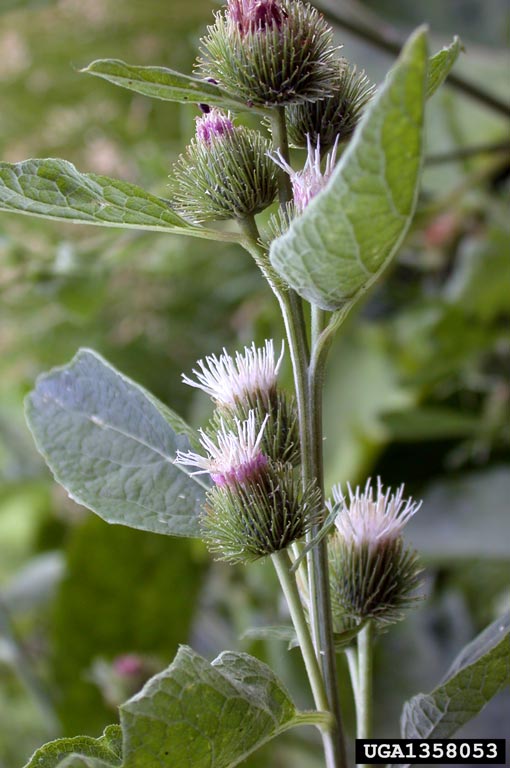


Photo credit:
Mary Ellen (Mel) Harte, Bugwood.org
Ohio State Weed Lab , The Ohio State University, Bugwood.org
Name: Common burdock (Arctium minus)
How to ID: Stems are erect, thick, coarse, and branched. They have a tinge of red/purple and can be grooved or angular. Mature plants grow 1 – 3 m tall. Rosette leaves are large, hairy, and shaped like hearts. Due to their size, they shade out smaller plants. Leaves and stems alternate (broadest at the stalk). Leaf edges are toothed, or wavy, and have a dolly underside (dark green on the top). Flowers are purple and borne in short-stalked clusters around stems. Spiny, hooked bracts surround the flowers.
Characteristics/Traits: An introduced biennial that forms a rosette of leaves in the first year, and large, branches with flowers in the second year. Prefers areas with fertile soils and riparian regions. Produces burs. Its seeds are prickly and can easily attach to anything they contact. Seed production beings in July and lasts until the fall. Seeds shed continuously throughout the fall, winter and following spring. A mature plant can produce 6,000 to 16,000 seeds.
Adverse effects: Large leaf size blocks sunlight to plants below, reducing biodiversity and promoting monocultures. It also displaces native vegetation, alters soil chemistry, and increases erosions. Seeds spread very easily, making it easy to invade new areas. Burs catch on animal furs leading to discomfort and, in some cases, even death.
Prevention: Avoid soil disturbances if possible and replant native vegetation in regions that have been altered. Promote desirable, competing vegetation, while also trying to limit seed production by any infestations. Clean seeds and burs off of clothing, animals and anything else they may attach to.
Control: Grazing using livestock is possible as they do not mind it. However, they will trample it and promote the spread in riparian areas. Tillage will kill plants in rosette stage. Once mature it is intolerant of cultivation. Mowing and cutting can limit seed production but should only be done before flowering. Registered chemicals for Burdock can also be used.


Photo credit:
Steve Dewey, Utah State University, Bugwood.org
Jan Samanek, Phytosanitary Administration, Bugwood.org
Name: Common tansy (Tanacetum vulgare)
How to ID: Stems are often purplish-red, erect with dotted glands, and branched. There are many stems per plant that grow up to 1.5 m. Leaves on the stem are deeply divided into many narrow, individual leaflets that have toothed edges (fern-like). There are many yellow, button-like flowers that occur in dense clusters.
Characteristics/Traits: Perennial forb that reproduces by both seeds and rhizomes. It has a deep and robust root system that has the ability to produce numerous seeds. Forms dense stands. If consumed in large quantities it is toxic making it not an option for grazing animals.
Adverse effects: Regrowth after cutting makes it very hard to manage, as roots and seeds can remain viable for up to twenty-five years. It reproduces through large number of seeds and rhizomes forming dense strands that outcompetes native vegetation (further reducing biodiversity). Degrades environments, releases chemicals into the soil, and promotes erosion. Limits the quality of forage, as it cannot be consumed. It is very toxic.
Prevention: Avoid purchasing it, and if you see common tansy for sale anywhere, report it to local invasive species centres.
Control: Repeated mowing and picking by hand are the most effective methods to reduce the spread and limit seed production.


Photo credit:
M. Mickelson
Alex Katovich, Bugwood.org
Mary Ellen (Mel) Harte, Bugwood.org
Name: Creeping bellflower (Campanula rapunculoides)
How to ID: Stems are erect and purple, they can be either hairy or smooth, and grow up to 1 m or more. Leaves range from 3-7 cm long. Leaves lower on the stem are long-stalked and heart-shaped with a coarse, and toothed texture. Upper leaves are sessile and spear-shaped, with a few hairs on the surface. Flowers are light purple and grow higher up on the plant. Seeds are light brown, have small wings, and are found in the round fruit capsule that the plant produces.
Characteristics/Traits: Can survive long periods of drought and can tolerate different light conditions. Its creeping root system is resistant to some herbicides, making it hard to control. Flowers are pollinated by insects, but in some cases they can become self-fertile and still produce seeds. Plants can produce 3000 or more seeds per-year. These seeds spread easily due to their light weight and small wings.
Adverse effects: Very resilient, making it hard to get rid of. Aggressively outcompetes native plants for nutrients, sunlight, and water. Thick root systems choke out other plants. Thrives in disturbed soils that are lacking native species.
Prevention: Avoid wildflower mixes that contain Creeping Bellflower, and do not purchase any mixes that do not list their contents.
Control: Avoid using grazing as a control method. Cultivation is also not an option due to the root systems. Hand-pulling and cutting can be options (dispose of the plant in garbage can, not compost). Digging out as much of the root is very important when getting rid of the plant. Dig out after a good rain to knock this plant back.


Photo credit:
Rob Routledge, Sault College, Bugwood.org
Leslie J. Mehrhoff, University of Connecticut, Bugwood.org
Richard Gardner, Bugwood.org
Name: Dame’s rocket (Hesperis matronalis)
How to ID: Several erect stems per plant, growing 0.5 to 1 m tall (sometimes taller). Upper stems are often branched. Leaves are alternate and are spear-shaped, ranging from, 1-4 cm wide and 4-15 cm long. They are hairy and dark green on both sides, with serrated edges. Lower leaves on stem have short petioles (stems) and wither by flowering. Flowers can be white, pink, lavender, or purple. They contain four petals and range from 8-12 mm wide. Flowers are borne in loose clusters at the top of stems. Seed pods are long (0.5 to 1.5 cm) and become papery as they mature. Seeds are black and 1-1.5 cm long.
Characteristics/Traits: Can be a biennial or short-lived perennial. It is a prolific seed producer and a member of the mustard family. Flowers are insect pollinated and very fragrant (especially in the evening). It produces a rosette in the first year of growth and then a flowering bolt in the second year. Blooms in early summer, and stems wither and die by late summer.
Adverse effects: Forms dense monocultures that choke out native species by outcompeting them for sunlight, water, and nutrients. Reduces biodiversity in woodlands, prairies, and riparian areas. Plants can produce high numbers of seeds that spread easily. Alters soil quality and nutrient cycling.
Prevention: Avoid wildflower seed mixtures and do not purchase any seed mixes that do not list the Latin names of the contents. Re-plant disturbed areas with native plants to prevent invasions. If deadheaded, plant will re-bloom.
Control: Cultivation and grazing are not suitable control options. Hand pulling is considered the most effective method, as roots come out easily from moist soils. Plant can also be dug out easy with a knife. It is important to note that plant density can increase the next year due to disturbance, but repeated removal will exhaust the seed bank. Burning is also effective.


Photo credit:
Chris Evans, University of Illinois, Bugwood.org
>Leslie J. Mehrhoff, University of Connecticut, Bugwood.org
Name: Downy brome (Bromus tectorum)
How to ID: Stems are hairy, erect, and can range in height from 10 to 70 cm. There can be 1-20 stems per plant. The plant turns from green to purple to brownish-tan as it matures. Leaves are 4-16 cm long and 2-4 mm wide. Ligules are around 2 mm long and membranous with entire or jagged edges. Auricles can be absent. Sheaths are closed near the top and hairy. Seedlings have hairy and bright green leaves. Flowers are usually closed and self-pollinating, but they can also cross-pollinate. The inflorescence (seed head) is a drooping, one-sided panicle with 5-8 florets. Florets are 2-4 cm long (including awns) and are usually purple at maturity.
Characteristics/Traits: Annual grass (typically a winter annual) that reproduces only by seed. It behaves as an annual when early spring or limiting fall moisture occurs. It is the most active the cool-season. It develops rapid lateral and vertical fibrous root systems to compete with perennial vegetation for moisture. Very aggressive in dry grasslands, especially when there is overgrazing. Plant size depends greatly on site conditions, and second seed crops can form from additional tillers. Seed production varies from 25 to 5000 seeds per plant. It needs to germinate early or late in the season, as hot and dry conditions kill seedlings. Not a strong competitor when around dominant perennials, but once established it will outcompete native plants for moisture. Seeds can survive low-intensity fires, especially if the are buried.
Adverse effects: Outcompetes native vegetation for moisture and forms dense monocultures once it has invaded a region. It accumulates litter that dries out during the summer months, leading to an increase in fire risk in affected regions. It is a strong competitor post-fire. Infestations increase soil erosion and alter ecosystem diversity.
Prevention: If visiting a region with Downy Brome, take proper steps to ensure that seeds have not attached themselves to clothing, shoelaces, and animal fur. Minimize amounts of disturbed sites as it requires some type of disturbance to establish effectively.
Control: Grazing is an effective method for controlling invasions. However, it should be done before the plants turn purple in colour to prevent seed formation and to be effective. Fertilizing desirable species to compete with Downy Brome is a good control method. It can also help to fill any voids in areas where the plant has been removed. Moving can be effective to prevent seed spread, but since plants can be at different life stages, it can spread seeds further. Tillage and hand pulling are effective methods when combined with other control methods but must be deep enough (10-15 cm) and repeated frequently. Certified chemicals can also be used to control invasions.

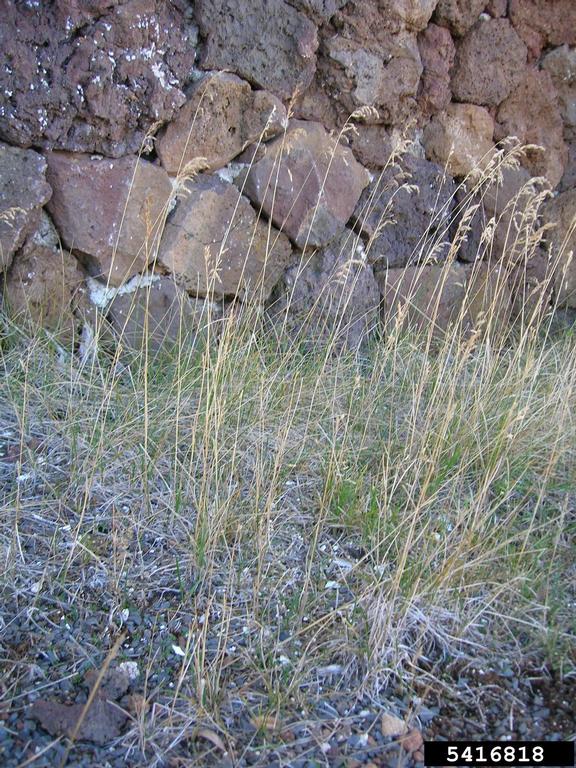
Photo credit: Ohio State Weed Lab , The Ohio State University, Bugwood.org
Name: Kentucky bluegrass (Poa pratensis)
How to ID: Perennial grass that usually grows about 15 cm to 1 m tall. Its leaves are smooth, narrow, and soft. Leaf tips have a distinct boat-shaped form. It produces an open, pyramid-shaped seed head and also spreads through rhizomes underground, forming dense mats of grass.
Characteristics/Traits: Perennial grass that grows well in cool climates and is one of the most widely distributed grasses across the continent. Spreads by both seed and through underground rhizomes, allowing it to form dense grass mats, making it a fierce invader.
Adverse effects: Rapid ability to spread due to being able to grow from seeds and rhizomes. Aggressively outcompetes native plants and can invade natural ecosystems such as prairies and grasslands. Forms dense monocultures, decreases biodiversity, and increases soil erosion.
Prevention: Limit disturbance of natural grasslands and avoid planting it near native ecosystems. Maintaining healthy native plant communities helps to prevent it from establishing and spreading.
Control: Repeated mowing and grazing can reduce growth. Prescribed burns in grasslands, herbicide treatment in heavily invaded areas, and restoring native plant species to compete with it are also all effective methods to limit invasions and stop it from spreading even more.


Photo credit:
Rob Routledge, Sault College, Bugwood.org
L.L. Berry, Bugwood.org
Leslie J. Mehrhoff, University of Connecticut, Bugwood.org
Name: Knapweed sp. (Centaurea sp.)
How to ID: Upright and branched stems that grow up to 1.5 m tall. The number of stems depends on plant. Rosettes are up to 15 cm long and deeply lobed. On bolting stems, leaves alternate, and become divided, they grow feather-like, and sometimes hairy. Flowers are borne at the end of branches and are pinkish-purple (occasionally white). Bracts on the flower’s base have black tips. Seeds are brown, oval-shaped, and range from 1.5 mm to 3.175 mm long.
Characteristics/Traits: Primarily biennial plant, producing rosettes the first year and flowering bolts the second year. However, it can also be a short-lived perennial that blooms for a few years before dying, or an annual. It can self-pollinate, but is also cross pollinated by insects.
Adverse effects: Very prolific seed producer, as a single plant can produce over 140,000 seeds per year. Seeds can be viable for 5-10 years. Control is extremely difficult in established infestations. It has degraded massive amounts of rangeland. Plant skeletons break off in the winter and blow around in the wind, spreading seeds and causing more invasions. Roots release a chemical that inhibits the root growth of other plants.
Prevention: Use caution when hay from road ditches or purchasing it from infested areas as Knapweed can contaminate it. Plant skeletons can also often get caught under vehicles, leading to seeds being distributed across different areas.
Control: Due to the hard seed coat, control sites need to be revisited for many years to completely stop the spread and invasion. Grazing can be used; however, seeds will still spread through animal droppings. Grazing when the plant is in the rosette stage is the most effective when combined with herbicide treatment. Cultivation is effective and reduces Knapweed. Cutting and pulling can be effective for small infestations, but must be done repeatedly to eradicate the area (as much of the root as possible must be removed to prevent re-sprouting).


Photo credit:
Chris Evans, University of Illinois, Bugwood.org
Rob Routledge, Sault College, Bugwood.org
Name: Leafy spurge (Euphorbia virgata)
How to ID: Stems are arranged in clumps, hairless and smooth, they grow up to 1 m tall, and contain a milky latex. Leaves are numerous and attached directly to the stem. They are arranged alternately, or sometimes spirally. Leaves are up to 7 cm long, waxy, narrow, have smooth edges, and are blueish-green in colour, turning yellowish or reddish-orange in late summer. Flowers are small, yellowish-green, and lack both petals and sepals. They are supported by two green, heart-shaped, leaf-life bracts, arranged in many clusters. Seeds are 2 mm long, light grey to dark brown in colour, and grow in pods at the top of bracts. When mature seeds dry out, seed pods explode, distributing seeds as far as 5 m from the parent plant.
Characteristics/Traits: Long-lived perennial that reproduces primarily by re-sprouting from its creeping root system and also by seed. Roots can extent 4.5 m laterally and about 9 m deep. Forms dense stands over time, and large plants are capable of producing up to 130,000 seeds. All parts of the plant contain a milky latex that can poison livestock and cause skin irritation in humans.
Adverse effects: Toxic to livestock and harmful to humans, causing skin irritation. Displaces native species due to early spring growth. Aggressively regenerates and rapidly outcompetes other species. Releases chemicals that limits the growth of surrounding plants. Reduces habitat, promotes soil erosion, and degrades soil water content.
Prevention: Use caution when using hay from roadside ditches and when purchasing hay from unknown regions. Use weed-seed-free hay. Isolate animals in a contained area for a week if they were in infested areas so seeds can exit the body. Wash the undercarriages of vehicles that were in infested areas in a commercial area to remove any seedlings, stems, or flowers (ensure they are washed down the drain). Do not get soil or gravel from an infested area.
Control: Leafy Spurge is very resilient, so a combination of control methods will be needed to achieve control. Sheep and goats can be used to control the plant through grazing (which runs risk of seeds spreading through droppings). If done right, cultivation is an effective method. Mowing and hand-pulling are effective only on small, young infestations (wear gloves to avoid rashes). Registered chemicals can be used as well to control and stop the spread.


Photo credit:
Richard Gardner, Bugwood.org
L.L. Berry, Bugwood.org
Name: Nodding thistle (Carduus nutans)
How to ID: Stems in the first year form a large rosette. In the second year they grown between 20 cm to 2.5 m tall. Stems lower on the plant have spiny, lengthwise ridges. Either one or many stems can grow from one root crown. Leaves alternate, are a deep green with a light green vein, they have a waxy surface, and are sometimes hairy. Edges are spiny and leaves are deeply lobed, growing up to 25 cm long with white margins. Flower heads are solitary at the end of stems, about 3-5 cm in diameter, composed of hundreds of tiny little reddish-purple flowers. At the base of each head there are several rows of spiny bracts. When mature, flower heads often droop (how it got its name). A single flower head may produce up to 1200 seeds. The plant dies after seed set. Seeds are 4-5 mm long, with longitudinal dotted stripes. Pappus bristles on the seeds are 13-25 mm long.
Characteristics/Traits: Biennial or winter annual that only reproduces by seed. Rosettes can become quite large.
Adverse effects: It is a rangeland pest, that leads to severe degradation of native grasslands. Grazing animals focus on native plants, this gives nodding thistle an advantage and opportunity to take over areas, reducing biodiversity.
Prevention: Learn how to recognize the invasive plant when it is young to eradicate it early on and prevent the spread.
Control: When young, plants can be grazed by sheep and goats. Grazing must be managed and done properly to avoid larger infestations. Frequent cultivation is effective. Hand-digging and mowing before seed set are effective as long as debris is collected and burned. Severing the tap root below the ground surface will kill the plant. Certified chemicals can also be used to control the plant as well.


Photo credit:
Mary Ellen (Mel) Harte, Bugwood.org
Becca MacDonald, Sault College, Bugwood.org
Steve Dewey, Utah State University, Bugwood.org
Name: Oxeye daisy (Leucanthemum vulgare)
How to ID: Stems are smooth, sometimes grooved, occasionally branched near the top, and grow up to 1 m tall. Leaves decrease in size upwards on the stem. Basal and lower leaves are spear-shaped, with toothed margins and petioles that can grow as long as leaves. Upper leaves are alternately arranged, narrow, and clasp the stem. Flowers are borne at the end of stems and can be up to 5 cm in diameter, with yellow centers and 20-30 white petals that radiate from the centre (petals are notched at the tip).
Characteristics/Traits: Perennial that spreads primarily by seed, but roots also produce rhizomes.
Adverse effects: Flowers can produce over 500 seeds, but a plant can produce up to 26,000 seeds. Their spread greatly impacts forage production in pastures and meadows. Dense stands of this plant decrease diversity and increases the amount of bare soil, leading to decreased vegetation and increased erosion.
Prevention: Avoid and carefully read wildflower mixes to prevent accidentally introducing the plant into unaffected regions.
Control: Horses, sheep, and goats effectively graze oxeye daisy. Intensive grazing and trampling reduces the number of seeds produced and injures the younger root stocks. Repeated mowing prevents seed production, but can also stimulate re-sprouting. Hand pulling is effective as long as much of the root is removed, but it will be needed to be done repeatedly. The plant will also be easily killed by intensive cultivation. Registered chemicals can also be used.


>Photo credit:
Mark Schwarzlander, University of Idaho, Bugwood.org
Becca MacDonald, Sault College, Bugwood.org
Rob Routledge, Sault College, Bugwood.org
Name: Purple loosestrife (Lythrum salicaria)
How to ID: Stems are square-ish and woody, having four to six sides. Mature plants can reach a height of 3 m and form short lateral branches. The average plant height is 1 to 1.5 m. Leaves are stalkless and opposite, sometimes whorled near the base, spear-shaped, and wider near the stem (3-10 cm long). Leaves are sometimes covered in fine hairs. Flowers are a reddish-purple (sometimes white or pink) and have 5-7 petals. Blooming begins at the bottom and progresses upwards. Seed capsules are 2 mm wide and 3-4mm long. Tiny seeds are less than 1 mm long and can only germinate early in the season.
Characteristics/Traits: Perennial of freshwater habitats such as, marshes, water-filled ditches, natural waterways, and irrigation canals. It has a tremendous reproductive capacity. Stems increase in number each year. Mature plants can have 30-50 stems per root stock. Plants bloom throughout the growing season, and a single plant can produce more than one million seeds each year. Flowers are pollinated by bees and butterflies.
Adverse effects: Infestations quickly take over wetlands, reducing wildlife, as nesting for waterfowl and water living mammals decreases and cover for predators increases. Invasions also disrupt water flow.
Prevention: Irrigation systems provide ideal habitat and seed distribution. New plants can arise from stem and root fragments and can be transported in wetland mud. Purchasing this plant should be avoided completely, and any infestations should be handled immediately.
Control: Hand pulling and manually cutting can be used to eradicate small infestations. Mature plants can be cut down in the late season to reduce re-sprouting. However, there is risk of spreading seeds, and any cut or pulled plants must be bagged and disposed of properly in a landfill or burned. These actions will need to be repeated for a few years to be fully effective.


Photo credit:
K. George Beck and James Sebastian, Colorado State University, Bugwood.org
Caleb Slemmons, National Ecological Observatory Network, Bugwood.org
Bruce Ackley, The Ohio State University, Bugwood.org
Name: Scentless chamomile (Tripleurospermum inodorum)
How to ID: Stems are highly branched, may be reddish in colour, can grow up to 1 m tall, and are erect and semi-erect. Leaves are alternate and divided finely into short segments (carrot-like) and odourless when crushed. Basal leaves disappear by flowering time. Flowers have a yellow central disk that is surrounded by white petals. Flowers are borne singly at the end of stems. They have numerous bracts and are arranged in overlapping rows. Seeds are about 2 mm in size, ribbed, dark brown and develop quickly.
Characteristics/Traits: Behaves as an annual, biennial, or sometimes a perennial, reproduces by seed only. Plants have a fibrous root system and are usually bushy. It continuously grows throughout the growing season. Often confused with Oxeye Daisy, but their leaves are very different and scentless chamomile generally has smaller flowers.
Adverse effects: A single plant can take up a full square meter of space and produce up to one million seeds. Rapid colonization reduces and displaces native vegetation. Thrives in wetlands, surpasses the growth of native seedlings, and alters habitat soil moisture as well as nutrient cycling. Very hard to control due to its ability to behave as either annual, biennial, or even perennial.
Prevention: Does not compete well with healthy, vigorous plant communities. Healthy native plant communities make it hard for it to invade. Usually dispersed by weed seed contamination in grass and crop seed.
Control: Late fall and early spring tillage will control rosettes. Must be done frequently and shallowly to exhaust the seed bank and destroy germinating seeds. It is important to clean equipment after to avoid further spread. Mowing can prevent seed production, but plants will re-bloom. Hand-pulling can prevent spread and is effective on small invasions. Plants must be bagged and sent to the landfill or burned to prevent spread. Correct registered chemicals can also be used.


Photo credit:
Joseph M. DiTomaso, University of California – Davis, Bugwood.org
Forest and Kim Starr, Starr Environmental, Bugwood.org
Name: Smooth brome (Bromus inermis)
How to ID: Tall perennial grass that typically grows about 40-100 cm tall. Has long leaves that are flat and smooth. Often shows a “W-shaped” crease across the leaf blade. Produces multiple seeds from a branched seed head (panicle). Spreads through underground rhizomes, forming dense patches of grass.
Characteristics/Traits: Perennial grass that spreads quickly through seeds and underground rhizomes. Forms dense patches of grass that invade grassland ecosystems.
Adverse effects: Reproduces rapidly, outcompeting native species and reducing ecosystem diversity. Very tolerant, can survive extreme cold and dry conditions.
Prevention: Limiting movement of seeds between areas and monitoring disturbed sites. Cleaning equipment, vehicles, and footwear after travelling through infested areas helps to reduce the spread. Early detection of new growth patches makes it easier to remove and restore the region.
Control: Mow or cut plants before they produce seeds. Prescribed burning, herbicide treatments, repeated monitoring, and management are also effective methods for mitigating invasions.
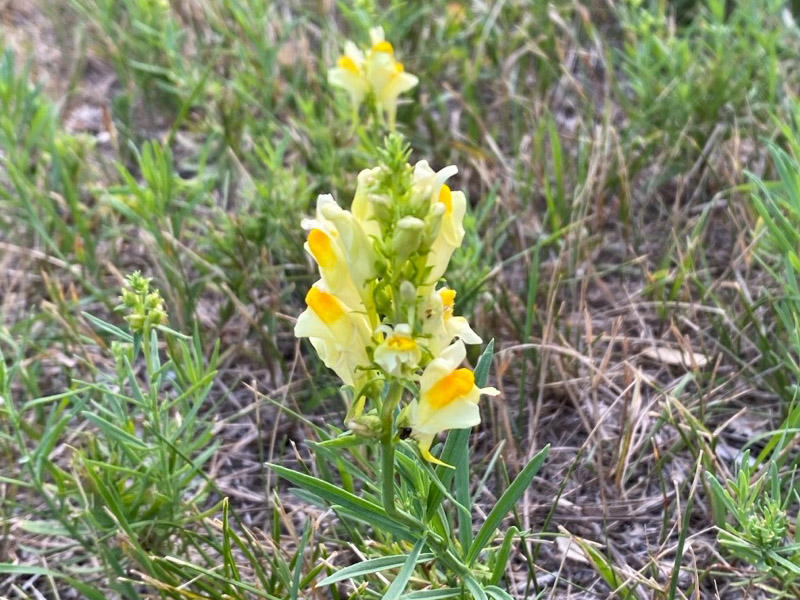
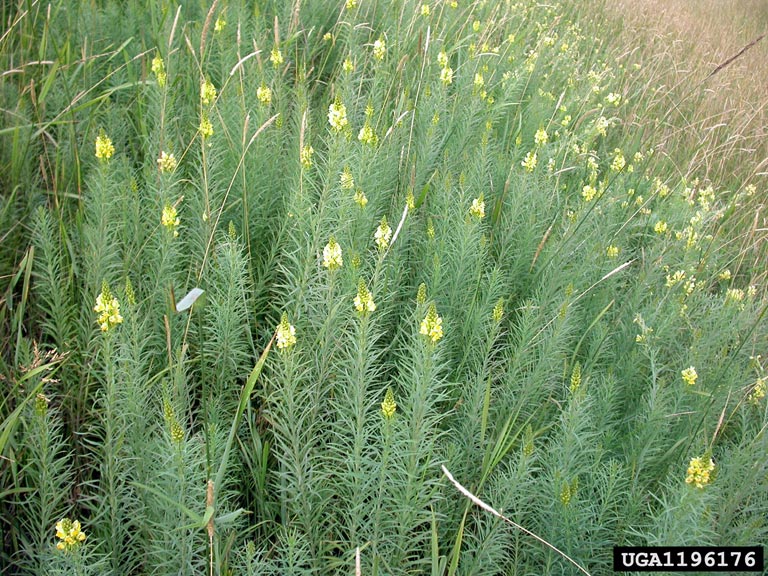

Photo credit:
Michael Shephard, USDA Forest Service, Bugwood.org
< Steve Dewey, Utah State University, Bugwood.org
Name: Yellow toadflax (Linaria vulgaris)
How to ID: Stems are hairless, erect, un-branched, and range in size from 15 cm to 1 m tall. Mature plants can have 1-25 stems. Leaves are soft, spear shaped, and pale green. Leaves are alternate but sometimes appear opposite on the lower stem due to crowding. Leaves can be up to 10 cm long and attached directly to the stem. Flowers are bright yellow, arranged alternately in dense spikes at the end of stems, and have long spurs extending from base (usually as long as the flower). Flowers range from 2 – 3.5 cm long. Seeds are winged, disk-shaped, and dark brown.
Characteristics/Traits: Perennial plant that reproduces primarily from its creeping root system (rhizomes). Seedlings 2-3 weeks old already begin producing creeping roots, allowing it to reproduce rapidly.
Adverse effects: Its ability to form large colonies allows it to suffocate and crowd out native plants, leading to decreased biodiversity, degraded habitats, and monocultures.
Prevention: Avoid purchasing wildflower mixes and carefully read labels to avoid spreading this invasive plant.
Control: Repeated cultivation can effectively destroy the root system (clean equipment after use). Hand-pulling is effective in soft soils where the entire root system can be pulled out. This must be repeated to deplete the seed bank and remove all root pieces. Registered chemicals can also be used.